Park Fever
Park Fever Mods Game























How To Play Park Fever
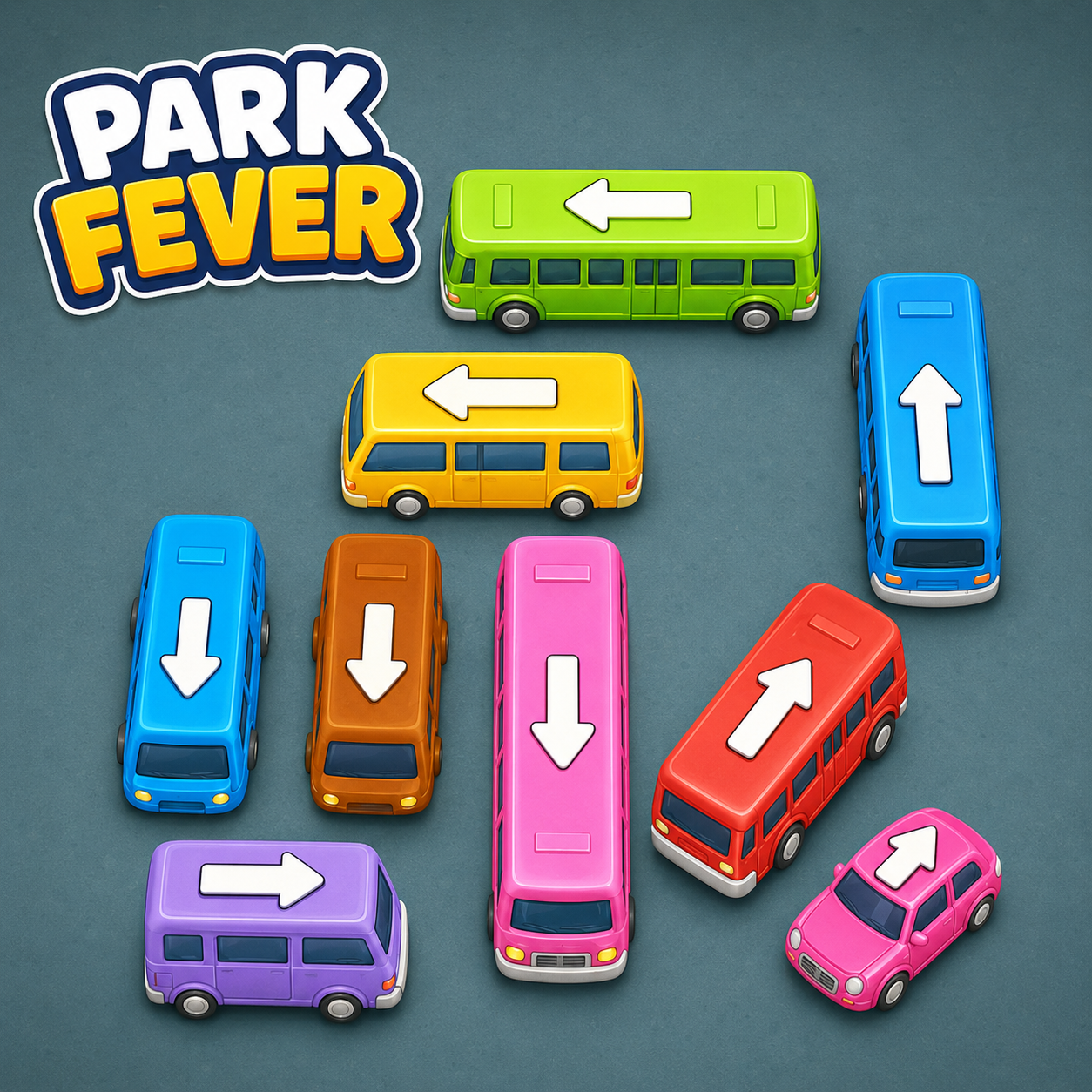
At the heart of Park Fever lies a straightforward yet engaging mechanic: players click or tap an accessible car to pull it from the parking lot. Every vehicle is fitted with a directional arrow that determines its movement trajectory, so it cannot leave if another automobile is blocking its route. A defining feature of the gameplay loop is the ripple effect created by freeing up space—relocating a car near the exit can clear a direct path for multiple other vehicles that were previously stuck further inside the lot. Once a car departs the parking area, it is sent to one of the open bays located alongside the passenger waiting line. The interaction rules are strictly based on color: riders may only enter a vehicle that matches their assigned color, and each car has a finite seating capacity.
The passenger queue introduces a crucial strategic dimension. Since riders board exclusively from the head of the line, there is no way to skip one color in order to assist a group positioned further back. This forces players to continuously monitor the colors of incoming passengers and decide which vehicles need to be guided toward the boarding station. The capacity limitation adds yet another layer of complexity; a compact car might be able to accommodate only a fraction of a sizable group waiting in line. In that situation, a second vehicle of the same color must be brought out before the next group in the queue can proceed to board, guaranteeing that every passenger is handled in the proper sequence. This design creates an ongoing cognitive cycle of strategizing, acting, and reassessing with each new movement.
Park Fever Wiki
Summary
Park Fever is a thoughtfully designed traffic-management puzzle game from GameBerry Studio, inviting players to direct the smooth and orderly exit of vehicles from parking facilities that grow increasingly intricate. Each level presents a mentally engaging scenario composed of a densely packed parking area, multiple temporary holding zones, and a waiting line of passengers distinguished by color, all of which combine to form a dynamic and ever-shifting puzzle environment. The core objective appears simple at first glance, yet it carries a surprising level of difficulty: vehicles must be released in the proper order, and every passenger must ultimately be transported away from the station. Although the controls are refreshingly straightforward, the layout of each stage demands considerable strategic anticipation and deliberate planning. Players are continually required to assess which cars are eligible to leave based on their directional indicators, which passenger color is currently at the front of the queue, and how much capacity remains in the restricted holding areas. Park Fever sets itself apart through its elegant fusion of spatial awareness and ordered, sequence-driven problem solving, delivering a genuinely rewarding intellectual exercise for puzzle enthusiasts who value complexity emerging from simple, intuitive rules.
Key Features
Park Fever boasts a number of standout features that cement its reputation as a compelling puzzle title. Chief among these is its distinctive spatial puzzle mechanic, in which every action carries meaningful consequences. The directional arrows and obstruction-based movement rules compel players to plan several moves in advance, evoking the feel of a sliding-tile puzzle while layering on a thematic, traffic-oriented logic. The game also incorporates a passenger queue system with great skill, introducing a sequential reasoning component that ensures the solution never boils down to merely clearing every car from the lot. This interplay between spatial navigation and ordered dispatch guarantees that no two levels feel alike, given the immense variety of possible vehicle placements, capacity limits, and passenger orderings.
The game is built for broad accessibility across different platforms, featuring intuitive controls that work effortlessly in both desktop and mobile settings. On a computer, players simply click a vehicle with the left mouse button, while on a touchscreen device, a quick tap is all that is required. This direct and uncomplicated control scheme ensures that the challenge originates from the puzzle design itself rather than from awkward or overly complex mechanics. Additionally, the difficulty progression is meticulously balanced. Early stages introduce the fundamental concepts in a gentle, forgiving manner, whereas later levels present considerably more crowded parking configurations and a wider array of passenger colors. This gradual escalation sustains player engagement, continuously introducing fresh obstacles that test one's ability to juggle multiple constraints at once and devise efficient routes for the successful departure of every vehicle.
Precautions/Tips
To achieve success in Park Fever and steer clear of unnecessary frustration, players should keep several strategic precautions in mind. One of the most frequent mistakes involves poor management of the holding bays. Vehicles that do not match the passengers currently waiting in line must be stored in these bays, and the available space there is extremely limited. Releasing an excessive number of cars intended for future passenger groups, in an effort to empty the main lot, can quickly result in a station clogged with vehicles that cannot be used at the moment. The level ends in failure when every bay is occupied and none of the parked cars can accommodate the passengers at the head of the queue. As such, it is essential to keep at least one bay open whenever possible, serving as a safety margin that prevents an immediate deadlock.
Another vital piece of advice is to exercise restraint: avoid moving a vehicle unless it directly assists the current queue or opens up a crucial pathway. Activating a car without a well-defined purpose often worsens the congestion, consuming a valuable bay and obstructing routes that more relevant vehicles might need. It is also important to pay close attention to the passenger capacity of each car in relation to the size of the waiting groups. If a large cluster of, for instance, red passengers is next in line, make sure enough red vehicles have been released to transport all of them before shifting focus to the next color group. Finally, although boosters become available in later stages and can help correct errors, they should not be treated as a primary strategy. The most dependable route to mastery lies in carefully observing the queue order, thoughtfully planning each vehicle's movement, and maintaining a sharp awareness of spatial limitations. Always think several steps ahead, and survey the entire grid before initiating any sequence of actions, in order to reach an efficient and successful conclusion.
Park Fever Frequently Asked Questions
Q: What is Park Fever?
A: Park Fever is a vehicle-flow puzzle created by GameBerry Studio. Every stage includes a congested parking lot, a number of staging zones, and a line of passengers identified by distinct colors.
Q: What is the objective in Park Fever?
A: The objective is to dispatch the cars in the proper sequence and ensure that every passenger is able to depart from the station.
Q: How can I extract a vehicle from the parking area?
A: Press or touch a vehicle that has a clear path to move it out of the parking area. Each car travels only in the direction indicated by its arrow, so it cannot exit when another vehicle blocks its route.
Q: How do passengers get into the cars?
A: Passengers are allowed to board only a car of a matching color, and each car has a restricted number of seats. They board in order from the front of the queue, so you cannot bypass one color to pick up a group located further behind.
Q: What is the purpose of the holding bays?
A: Cars that are incompatible with the passengers currently waiting are required to wait in the holding bays. These spaces are scarce, so dispatching an excessive number of vehicles with upcoming colors can rapidly congest the station.
Q: When does a stage end in failure?
A: A stage ends in failure when all open waiting zones are filled and no parked car is able to accommodate the passengers waiting at the head of the line.
Q: What happens if a car can carry only a portion of a group?
A: A compact car may have capacity for only part of a large group. In such a situation, a second car with the same color must be brought in before the next group can start boarding.
Q: What input methods are supported on PC and mobile?
A: On PC, use the primary mouse button to click a car. On mobile, touch a car to choose it.
Q: What role do boosters play in the game?
A: Boosters can assist in fixing errors, but the surest method to advance is to strategize the sequence of your actions.
Q: How do subsequent stages differ from the earlier ones?
A: Subsequent stages feature more tightly packed parking layouts and a greater variety of colors.
Q: Is it possible for a car to exit when another vehicle blocks it?
A: It cannot. Each car travels only in the direction indicated by its arrow, so it is unable to leave when another vehicle obstructs its path.
Q: What factors should be examined prior to choosing a car?
A: Before choosing a car, examine the colors of the passengers who will arrive next and verify that the necessary vehicles are able to access the station.
Q: What is the reason for reserving an empty waiting zone?
A: Maintain at least one vacant slot at all times if feasible, since a stage ends in failure when all open waiting zones are filled and no parked car can serve the passengers at the front.
Q: Which approach offers the greatest reliability for advancing in the game?
A: Devising a deliberate sequence for your actions offers the greatest reliability for advancing in the game.