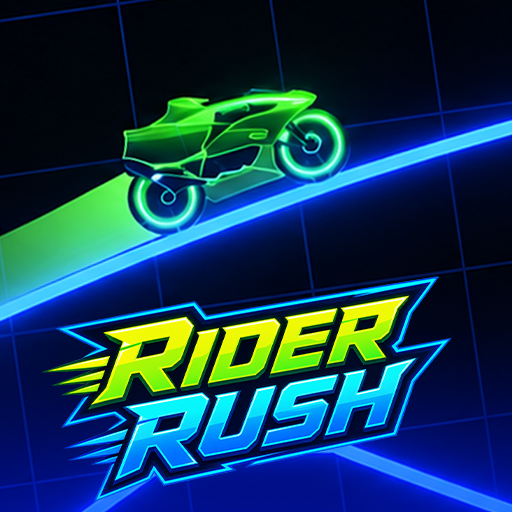
Rider Rush
Rider Rush Mods Game
Sprunki Phase 9 Ggtp

Rooster Road
Please Do Not Feed The Sprunki Brud
Endacopia

Basketball Hit
Flying Car Game Police Games
My Talking Tom Cat But With Oren
Park Fever

Goalheads Io
Flip Or Fail
Classic Sudoku Puzzle
Skillful Finger
Tomb Of The Mask Neon
Boboiboy Galaxy Run

Sprunki Footlongs Sandbox
Hamster Maze
Blobade
Flip Duel
Wheely 2
Obby Tower

How To Play Rider Rush
The mechanics of Rider Rush are built upon three fundamental pillars: velocity regulation, mid-air maneuvering, and hue synchronization. Achieving success demands that players fuse these components together effortlessly.
To begin with, managing your velocity is of paramount importance. The luminous circuits feature loops, bends, voids, and sharp descents that all depend on forward momentum. Riders must apply throttle in order to generate sufficient pace to clear these obstacles. Yet keeping the throttle pinned indefinitely is a risky strategy. Extreme velocity reduces the rider's ability to steer, particularly when nearing stretches where the track's shade transitions. The solution lies in accelerating with intention and releasing the gas as needed to preserve balance.
Next, commands in the air are equally vital. Once the motorcycle departs from the circuit, the rider can utilize rotation inputs to execute forward somersaults, backward somersaults, or merely tweak the angle at which they touch down. Such actions help orient the vehicle correctly relative to the roadway. Nevertheless, tricks ought to be tried only under circumstances that are secure. Spinning without clear intent often results in clumsy touchdown events and wipeouts. The foremost concern must always be setting down securely with both tires contacting the surface.
Third, aligning hues is a distinctive and mandatory gameplay component. The path in front is frequently painted in certain colors, and the rider's vehicle has to adopt the exact same tone as the pavement prior to crossing it. This calls for quick reflexes and exact timing, especially when moving quickly or whenever multiple colored segments are placed in close succession. If the correct shade is not selected, an instantaneous wreck is inevitable. Because of that, players need to continuously survey the upcoming course and shift colors at precisely the correct instant.
In the end, advancement is achieved through consistent training. Subsequent stages present more complex track configurations that require refined abilities and careful accuracy. It is common for players to encounter the same hurdle multiple times before overcoming it. That repetition is an essential element of the improvement cycle. Through dedicated rehearsal, one can synchronize throttle management, aerial spins, and shade selection with greater fluidity. Eventually, even the toughest luminous courses in Rider Rush can be mastered.
Rider Rush Wiki
Rider Rush: A Precision Neon Motorbike Adventure
Summary
Rider Rush is a rapid online 2D motorcycle platformer where players handle a streamlined bike as it travels through winding, color-altering neon circuits. The main goal is straightforward: get to the finish line. Yet the route is far from straightforward. These circuits contain loops, bends, gaps, sharp inclines, and unexpected obstacles. Success depends on accurate driving, thoughtful throttle control, and strong awareness of the color system. Every leap, touchdown, and hue shift has to be precisely timed. One error can instantly terminate the run. Those who manage to combine velocity with command, and who anticipate the upcoming path, are rewarded. Thanks to climbing difficulty and numerous ever-more-intricate layouts, Rider Rush provides a demanding adventure for fans of skill-oriented arcade racing and platforming.
Key Features
What makes Rider Rush distinctive is its blend of rapid gameplay and exacting mechanics. Its primary features are:
- High-Speed 2D Motorcycle Action: The experience depends on swift reflexes and fluid handling. Riders take command of a refined motorcycle within a side-scrolling world where hesitation means failure.
- Color-Changing Glowing Tracks: The circuits are visually stunning, featuring luminous surfaces that shift hues. This element is not merely decorative; it forms a central game mechanic. To stay alive, players must align the motorcycle's shade with the current surface color.
- Varied Track Components: Loops, turns, empty sections, and severe inclines appear often. Such features demand careful momentum buildup and control. By continually adding fresh obstacles, the level layouts maintain participant interest.
- In-Air Trick Mechanics: During flight, players may rotate the motorcycle to execute acrobatic flips or fine-tune the touchdown angle. This introduces extra skill and flair, along with increased danger. Pulling off stunts is gratifying, but staying safe takes priority.
- Gradual Difficulty Ramp: The initial circuits are forgiving, and more complicated designs are introduced step by step. That creates a progression curve that challenges coordination and exactness as players move forward.
- Immediate Failure with Big Consequences: One slip-up can finish a run. This produces an anxious, high-pressure environment that attracts those who like tough arcade titles. It also pushes players toward skill mastery and replaying levels.
- Playable Online: Since Rider Rush is a browser-based online game, anyone can start racing with minimal setup. That accessibility suits short play sessions as well as long training blocks.
Precautions/Tips
Achieving success in Rider Rush demands more than fast reactions. Tactical thinking and prudence matter just as much. These suggestions will help players perform better and steer clear of frequent mistakes.
- Avoid Excessive Acceleration: Velocity is required to conquer loops and gaps, but too much throttle can cause the motorcycle to become unmanageable. Practice adjusting the accelerator. Let go of it when nearing sharp bends, color shifts, or sections where accuracy matters more than forward momentum.
- Focus on Secure Touchdowns: Executing flips and tricks in the air is tempting, yet dangerous. Try those maneuvers only when you are certain there is sufficient hang time and an unobstructed area to come down. When uncertain, employ the rotation controls solely to level the motorcycle with the track. A smooth landing beats a flashy wreck every time.
- Spot Color Shifts Early: Anticipation is essential for the color-matching system. Keep your eyes on the upcoming surface shade. When a transformation is visible, change the motorcycle's color as soon as you can. Delaying until the final instant produces errors, particularly when moving quickly.
- Remain Collected During Hard Parts: Certain circuits may feel impossible at first glance. Avoid allowing annoyance to dominate. Failing repeatedly is part of learning. Pause, inspect the level arrangement, identify danger points, and then make another attempt with a more focused plan.
- Weigh Risk Against Reward: Tricks can produce a feeling of accomplishment, but they are never necessary to advance. Concentrate on finishing the circuit without crashing. Try sophisticated moves only after you have learned the fundamentals and are familiar with the track.
- Train on a Regular Basis: This game heavily rewards muscle memory. Increased play time improves your coordination among throttle, rotation, and hue switching. If one level blocks you, continue practicing. Your abilities will advance, and the circuit will finally become manageable.
- Be Wary of Mixed Hues: Some sections feature multiple shades in close proximity. These are especially treacherous. Reduce speed if needed and change colors with accuracy. Sacrificing a little velocity is preferable to crashing and starting over.
To sum up, Rider Rush is a challenging yet gratifying game that assesses one's exactness, reflexes, and tactical reasoning. Through skill in throttle management, airborne adjustments, and color synchronization, participants can cross its hazardous luminous circuits and savor the rush of overcoming progressively harder tests. Regardless of whether you are a casual gamer after a brief challenge or a committed player hunting for a demanding skill-driven title, Rider Rush delivers a compelling adventure that pays off consistent training and accurate execution.
Rider Rush Frequently Asked Questions
Q: What is Rider Rush?
A: Rider Rush is a high-speed, two-dimensional motorbike platformer that you can play directly online. It puts you on twisting neon circuits that constantly change color, all packed with dangers, and your task is to get to the finish line without getting taken out.
Q: What is the main objective in Rider Rush?
A: The core objective in Rider Rush is to successfully tackle every jump, loop, slope, and abrupt obstacle that comes your way. You must cross the finish line while avoiding rollovers, crashes, or any other misstep that would instantly cut your ride short.
Q: Why is precision important in Rider Rush?
A: There is virtually no tolerance for errors here. You have to carefully manage the bike’s speed and forward motion, change colors at exactly the right instant, pull off stunts, and find your way through increasingly tough neon circuits. One tiny mistake can be enough to end everything.
Q: How should you handle loops, curves, gaps, and steep sections?
A: You should accelerate to gain enough momentum to get through these tricky parts, but it is equally important not to keep the throttle pressed any longer than necessary. Pushing the speed too high makes the motorcycle far harder to manage, especially on stretches where different colors appear close together.
Q: How do aerial controls work in Rider Rush?
A: When you are in the air, you can use the rotation controls to perform frontflips and backflips or simply adjust the angle at which you will land. Instead of spinning around just to show off, you should focus on touching down safely with both wheels aligned to the track.
Q: Why do you need to match colors in Rider Rush?
A: The track changes hue as you ride, and your bike’s color must always match the surface beneath you. Fast and accurate reactions are a must, particularly when you are moving quickly or when differently colored sections are situated right next to each other.
Q: What happens if you crash or flip over?
A: Crashing, flipping over, or making any other sort of mistake can bring your run to an immediate halt. In Rider Rush, one careless move is all it takes to see your attempt come to an abrupt end, forcing you to start over and try again.