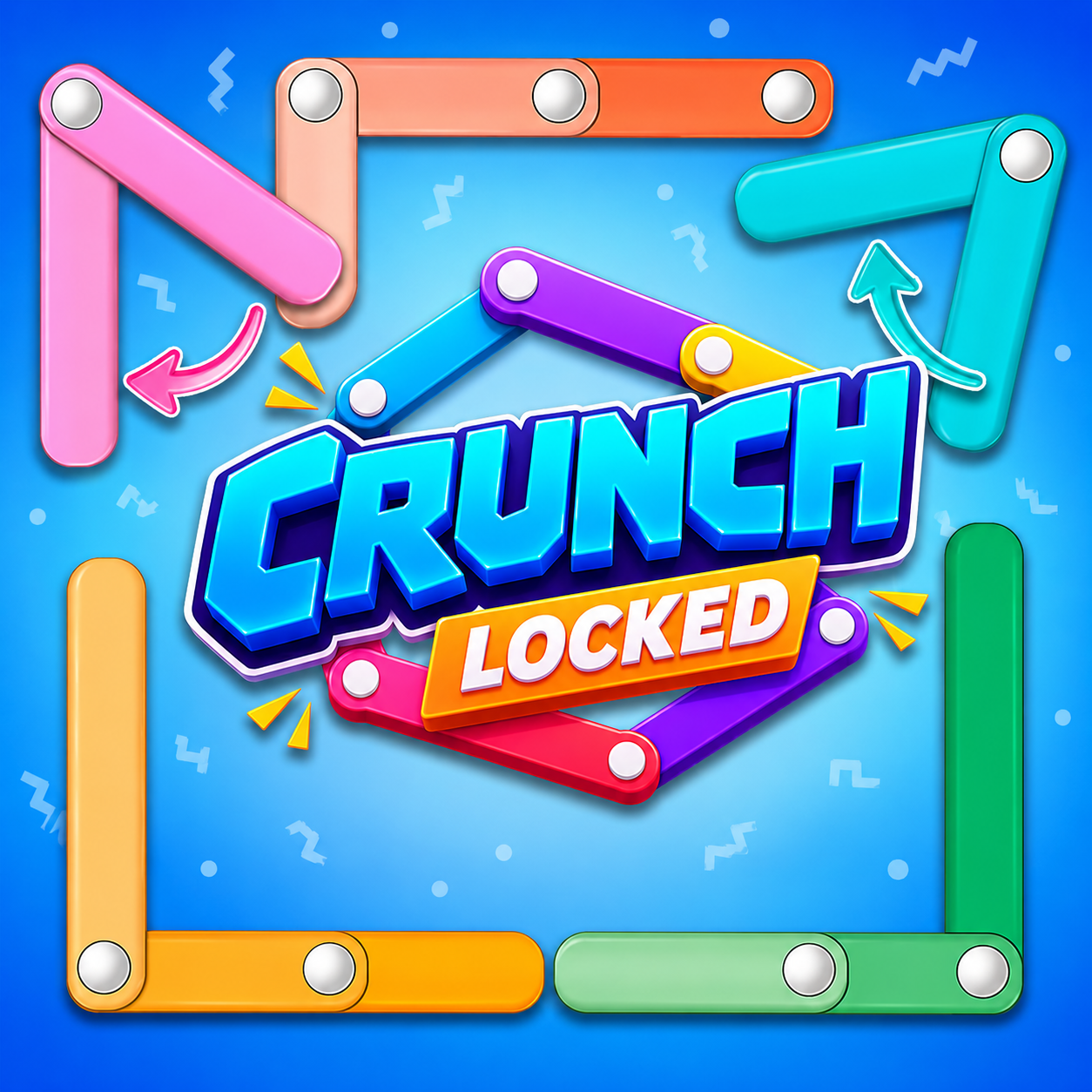
Crunch Locked
Crunch Locked Mods Game
Sprunki Phase 5 The Blackened Killer Remake
Candy Jump

Backyard Dig Hole 3d

Racing In City

Snakelandsio
Backrooms
Sprunki Rareshifted But Shifted
Blocky Runner
Jelly Runner
Brainrot Park
Neon Rush
Parking Adventure
Temple Of Boom

Retro Sports Champion
Bowling Master

Survival Race
Escape From Tsunami Brainrot
Aqua Bits
Sprunki Fake Skymon
Sprunki Phase 2 5 Definitive Edition Old Version

How To Play Crunch Locked
The primary mechanic in Crunch Locked is highly straightforward: players press (on desktop) or select (on mobile) any rotatable element to turn it 90° in a clockwise direction. Yet, the core of the gameplay lies in the hidden rules that determine which elements can be moved at any particular time. Every level starts with a disordered grouping of linked elements, laid out in a two-dimensional plane. The objective for the player is to collapse these elements sequentially until the entire formation vanishes completely.
In order to accomplish this, players need to grasp the two categories of elements: unlocked elements and locked elements. Unlocked elements can be rotated instantly; their rotation path is clear, meaning no other component obstructs the arc of the turn. Locked elements, in contrast, are denoted by a visual cue (such as a lock icon or a unique hue) and cannot be rotated until the barriers preventing their motion are eliminated. These barriers usually consist of other components that overlap or intersect the locked piece’s intended rotational path. The difficulty involves identifying the correct order of operations: players must first remove unlocked elements to open up space, which may then release previously unreachable components. The rotation is always 90° clockwise, so each move dramatically changes the spatial relationships among the elements. A component that was once obstructed may become free after its neighbor is folded away, and the reverse also holds—a component that was free may become locked if the structure unexpectedly collapses onto it.
Becoming proficient at the game demands that players visuali
Crunch Locked Wiki
Summary Crunch Locked is a carefully designed puzzle game that challenges players to solve interwoven configurations through a process of step-by-step folding. At its foundation, the game presents an apparently straightforward goal: fold each movable component until the entire arrangement vanishes. Yet, beneath this simple surface lies a deeply strategic experience that demands logical analysis, spatial comprehension, and advance planning. Every stage introduces a unique setup of interlocked segments, some capable of free rotation while others are secured behind barriers. The player’s assignment is to determine the correct sequence of actions—turning each available piece 90 degrees in a clockwise manner—while adhering to the restrictions imposed by crossing paths and blocked components. The game’s advancement steadily increases in difficulty, ensuring that initial levels provide a gentle introduction to its mechanics, while later stages challenge even experienced puzzle enthusiasts. Crunch Locked sets itself apart by offering a tranquil yet intellectually demanding atmosphere, where the gratification of solving a puzzle is achieved through thoughtful analysis rather than speed. It appeals to those who appreciate logic puzzles that reward patience and systematic reasoning, and it provides a welcome alternative to action-oriented or time-constrained games. By removing unnecessary elements and concentrating on a single core mechanism, Crunch Locked delivers a pure, straightforward puzzle experience that is approachable for beginners yet substantial enough to captivate seasoned players.
To visualize the puzzle in three dimensions? Even though the display is two-dimensional, the folding action suggests that components pivot around their connection points, altering their orientation and often their relative position to other components. Players must keep track of which pieces are currently movable, which are fixed, and which actions are safe to perform without generating dead ends. The game does not penalize errors; players can reverse moves or restart the stage, but the genuine satisfaction comes from solving the puzzle using the fewest rotations possible. For complex stages, trial and error is expected, but the most effective solvers will examine the entire layout before executing any move. By systematically assessing each component’s present state and predicting how each rotation influences the whole, players can resolve even the most convoluted puzzles with elegance and accuracy.
Key Features Crunch Locked has several distinctive attributes that distinguish it from typical casual puzzle games. Foremost is its groundbreaking folding mechanism. Instead of sliding, exchanging, or matching tiles, the game requires players to rotate interlocking components within a confined area. This unique interaction creates a puzzle type that feels novel and mentally invigorating. The gradually increasing difficulty curve ensures a natural learning process: early stages present simple two- or three-component puzzles, while later stages feature extensive networks of up to a dozen pieces, often with multiple fixed segments that require careful sequencing.
Another notable feature is the fixed piece system. By designating certain components as immovable until others are cleared, the game introduces a hierarchy of actions that forces players to think in terms of cause and effect. This mechanism prevents random clicking from being a feasible strategy and rewards methodical planning. The clean, minimalistic visual design also deserves recognition. The components are easily distinguishable, with fixed pieces visually marked, and the interface lacks distracting elements. This clarity allows players to concentrate entirely on the logical challenge at hand. Additionally, the game includes undo and restart functions, which encourage experimentation without frustration. Players can safely test a sequence of moves and backtrack if they encounter a dead end.
The responsive controls across both desktop and mobile platforms ensure a seamless experience. On desktop, left-clicking a component rotates it; on mobile, a simple tap suffices. The game also provides tactile feedback—a subtle sound and visual cue when a rotation occurs—which reinforces the sense of progress. Moreover, the absence of time pressure is a deliberate design choice. Crunch Locked is a relaxing puzzle game; there are no timers, no scoring systems, and no penalties for slow play. This allows players to immerse themselves in the logic at their own pace, making it an ideal option for unwinding after a long day or for engaging in deep, focused cognitive sessions.
Precautions/Tips While Crunch Locked is accessible and forgiving, certain strategies can greatly improve a player’s success and enjoyment. The most important piece of advice is to resist the urge to press randomly. Many players, especially when stuck, fall into the habit of rapidly rotating components in the hope that something will work. This approach rarely solves complex puzzles and often leads to a more tangled state. Instead, take a moment to examine the full layout before making any moves. Observe how components overlap, which pieces appear to have clear paths, and where fixed components are positioned relative to free ones. This preliminary analysis can save numerous undo cycles.
Another critical precaution is to prioritize clearing free components first. Fixed pieces are designed to be solved later; attempting to force them early is pointless. Focus on rotating all movable components until no free pieces remain. At that point, new components may become available, and the puzzle’s progression becomes clearer. It is also advisable to plan two or three moves ahead. After a component rotates, the configuration changes. Anticipate how that rotation will affect the paths of neighboring pieces. If you can visualize the state after a sequence of moves, you are far less likely to create an unsolvable dead end.
Players should also pay attention to the direction of rotation. Since every rotation is 90 degrees clockwise, a component that is currently vertical will become horizontal, and the opposite also applies. This may seem trivial, but in tight spaces, the orientation determines whether a component will collide with others. Use the undo function freely. There is no penalty for backtracking, so do not hesitate to try a hypothesis and revert if it fails. Finally, for particularly difficult stages, step away and return later. A fresh perspective can often spot a solution that was previously invisible. Patience and deliberate observation are the foundations of success in Crunch Locked; speed is irrelevant. By embracing these practices, players can transform each puzzle from a frustrating tangle into a satisfying mental exercise.
Crunch Locked Frequently Asked Questions
Q: What is Crunch Locked?
A: Crunch Locked is a calm yet demanding puzzle game that assesses your reasoning, observation, and planning abilities. Each stage features a collection of connected pieces that must be collapsed in the proper sequence until the full assembly vanishes.
Q: How do you play Crunch Locked?
A: You begin with multiple linked segments arranged in a twisted configuration. Your objective is to collapse every movable component until the entire formation is fully cleared. Clicking on an available section turns it 90 degrees clockwise, but a section can rotate only if no other piece is obstructing its movement.
Q: What are the controls for Crunch Locked?
A: On a computer, use the mouse to left-click a movable section to rotate it 90 degrees clockwise. On a smartphone or tablet, tap a movable section to rotate it clockwise.
Q: What are locked pieces in Crunch Locked?
A: Locked pieces are sections that cannot be moved right away. They are labeled as "Locked" and will not rotate until nearby barriers have been cleared.
Q: How do you unlock a locked piece?
A: First concentrate on the sections that are free to move. Clearing these pieces opens up space and may free up restricted parts later in the puzzle. Observe the position, orientation, and stacking of each section.
Q: What is the goal of each puzzle in Crunch Locked?
A: The aim is to collapse all interlocked sections in the right sequence until the entire structure vanishes completely.
Q: What tips are there for solving difficult levels in Crunch Locked?
A: Examine how the sections overlap before executing any action. Begin with freely movable sections, then use those moves to clear paths for locked or restricted pieces. Plan several moves ahead rather than reacting to each individual rotation. Patience and careful observation are more valuable than speed.
Q: Why should you avoid clicking randomly in Crunch Locked?
A: Random clicking can lead to unnecessary rotations and mistakes. Skilled players examine the entire puzzle before making their first move to minimize errors.
Q: What should you do before making your first move in a level?
A: Pause to study how the sections overlap and identify pieces that can move without obstruction. Review the whole layout to determine the correct sequence.
Q: Is Crunch Locked available on mobile?
A: Yes. On mobile devices, you tap a movable section to rotate it clockwise, just as you would left-click on a desktop computer.
Q: What genre does Crunch Locked belong to?
A: It is a casual puzzle logic game.
Q: How can you report a bug in Crunch Locked?
A: There is a "Report a bug" option. You can choose the problem (e.g., game doesn't load, game not working, lost progress, inappropriate content, help with purchase, suggestion, other) and submit it.
Q: How can you share Crunch Locked with friends?
A: You can copy the link found in the "SHARE WITH YOUR FRIENDS" area.
Q: How do you leave a comment on the game page?
A: A comment section is available where you can type your remarks. You must read and accept the terms and conditions before posting.
Q: What issues can you report in Crunch Locked?
A: The available options are: "The game don't load", "The game is not working", "I lost my progress", "I saw something inappropriate", "I need help with an in-game purchase", "I have a suggestion", or "Other".