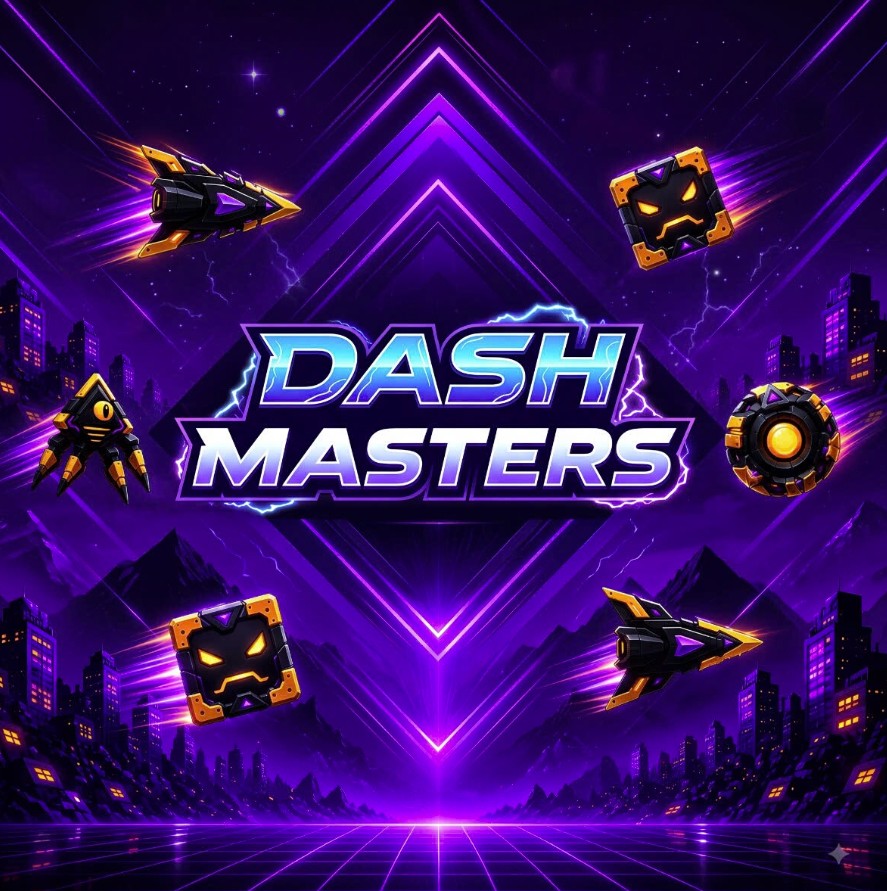
Dash Masters
Dash Masters Mods Game
Zombie Dash
Rainbow Tsunami
Shapik The Quest

Do Dragons Exist
Goat Rampage
Tower Rise
Horror Nun 2
Sprunki Square Shifted
Obby Survive Parkour

Bees Empire Clicker

Paint Or Hunt
Super Bear Adventure
Brave Squad
Sprunki Hyper Shifted Phase 3 Remastered
Left Or Right Spranki Beats
1 Speed Keyboard Lucky Escape
Traffic Racing
Rider Rush
Sprunki Phase 9 Ggtp
Rooster Road



How To Play Dash Masters
At its core, Dash Masters is a game built around a single input. On PC, players control the jump by clicking the mouse, pressing the Spacebar, or hitting the Up Arrow key. On mobile devices, a quick tap anywhere on the screen performs the same action. Because the icon advances automatically, the player's only task is to time jumps with precision. Each level is packed with dangers, including spikes, buzz saws, and moving platforms, and any contact with these obstacles abruptly ends the run and returns you to the very beginning. As a result, exact timing is essential.
The obstacles are laid out according to rhythmic patterns, and the soundtrack frequently provides useful cues. Pay close attention to the beat—many jumps are deliberately synchronized to prominent musical accents. Additionally, Practice Mode allows you to place checkpoints near difficult passages, which is invaluable for mastering tricky segments.
Dash Masters Wiki
Dash Masters: A Precision Rhythm Platformer Demanding Focus and Timing
Dash Masters stands as an energetic rhythm-based platformer that has drawn the interest of gamers who thrive on challenging, accuracy-driven play. It borrows heavily from the foundational approach pioneered by Geometry Dash, eliminating unnecessary mechanics and concentrating on one of gaming's most straightforward yet formidable challenges: pushing forward without pause while conquering every hazard encountered along the way. What emerges is a title that couples simplicity with considerable depth, requiring not only quick reflexes but also disciplined timing and the capacity to recognize patterns. Whether you're a seasoned rhythm enthusiast or a newcomer seeking a high-intensity arcade experience, Dash Masters delivers a refined and gratifying package. The sections that follow examine the game's central concept, its gameplay approach, standout qualities, and essential advice for elevating your performance.
Overview
Dash Masters is an energetic rhythm platformer featuring an ever-moving icon that must navigate obstacle-heavy stages. By merging the exactness of geometric platforming with the auditory cues of a musical soundtrack, the game demands rhythmic timing, memorization, and nearly instantaneous reactions. Players encounter a barrage of spikes, spinning blades, moving threats, and gravity-defying gateways, all while the musical accompaniment establishes the tempo. The core goal is straightforward: move the icon from the opening of each stage to its conclusion without crashing. Every attempt concludes in an immediate restart, pushing players to analyze their mistakes and progressively chart the correct route. Drawing from the fundamental mechanics of Geometry Dash, Dash Masters condenses the rhythm-platformer formula into a sleek and accessible product. It emphasizes steady rhythm and attentive observation instead of reckless input spamming. The game's structure guarantees that each failure presents a lesson, and every success arises from genuine proficiency.
How to Play
Beginning Dash Masters is straightforward; achieving mastery is a different matter entirely. The input scheme is deliberately minimal. On a computer, the mouse, Spacebar, or Up Arrow key triggers the icon to jump. On touchscreen devices, a simple tap performs the same action. Since the avatar moves forward automatically, there is no need to manage acceleration or braking. The entire gameplay loop is distilled into a singular decision: determining the right moment to leap.
However, that simplicity can be misleading. Every spike, blade, and platform demands exact timing. A jump performed just a single frame too early or too late generally ends the run. The game progressively unveils fresh mechanics to keep you alert. Portals represent the most impactful of these elements. Certain portals invert gravity, requiring you to instantly adjust your spatial awareness. Others modify the icon's velocity, which means the distance covered during a jump shifts mid-level. Some portals convert your icon into alternative shapes, such as a cube or a craft-like form, each possessing different movement properties. These transformations necessitate rapid adaptation and a thorough grasp of the game's fundamental motion.
Practice Mode stands out as an essential resource for improvement. In this mode, you can set checkpoints anywhere within a stage. This allows you to focus on a single problematic segment without replaying the entire level from the beginning. Practice Mode is not a mere convenience—it is a vital part of the learning process. The stages are lengthy and exacting, and attempting to learn a late-stage section through repeated full runs is inefficient. By isolating troublesome passages, you can devote concentrated effort to mastering precise jump timing and portal transitions. Once those actions become instinctive, you can connect everything into one complete, successful run.
The most important skill to cultivate is rhythm. Because Dash Masters aligns its obstacles with the musical beat, players who depend purely on visual reflexes will often find themselves overwhelmed. Instead, mentally tracking the melody allows you to internalize jump timings. The opening levels introduce this concept gradually with wider gaps and gentler tempos. Later stages demand quicker, more exact responses, where the music becomes an indispensable guide rather than simply background audio.
Key Features
Dash Masters might appear visually sparse, but its feature set is thoughtfully constructed to provide richness and variety within a deceptively simple framework. The following are the defining components of the experience.
-
Responsive and intentionally basic controls: The control layout is deliberately stripped down. With only one jump input on both PC and mobile, the game removes mechanical clutter and places the entire challenge on timing precision. This level of accuracy is highly satisfying for players who appreciate skill-driven, arcade-style gameplay.
-
Uninterrupted forward movement: The icon never halts, and you cannot alter its speed or direction. Instead, you must plan your jumps according to what lies ahead. This constraint forms the very core of the challenge, compelling players to look forward, anticipate upcoming dangers, and prepare mentally for each successive obstacle.
-
Portals and transformation mechanics: Certain stages contain portals that dramatically alter the icon's behavior. A gravity-reversal portal flips the environment, forcing you to land on ceilings. Speed portals either accelerate or decelerate the action, shifting the timing of every leap that follows. These additions keep the gameplay feeling fresh and introduce strategic depth, especially when multiple portals are encountered in rapid succession.
-
Music-integrated level design: The hazards in each stage are not arbitrarily positioned. Level layouts are synchronized with the soundtrack, making many jumps feel like musical notes within a larger composition. This synchronization serves a functional purpose beyond aesthetics—it offers a dependable timing reference. Players who can sense the beat will find the experience more intuitive and far less chaotic.
-
Practice Mode: This feature is invaluable for anyone determined to conquer difficult stages. It permits checkpoint placement and repeated attempts of brief segments without requiring a full restart. Far from being an optional extra, it functions as a training ground for pattern recognition and the development of muscle memory.
-
Progressive difficulty scaling: Dash Masters starts off forgiving enough to teach the fundamentals, then steadily introduces faster tempos, denser hazards, and more intricate portal combinations. The curve is engineered to make you feel tangible improvement as you advance, while still delivering a formidable challenge to experienced players.
Precautions/Tips
Achieving success in Dash Masters relies on mental readiness, familiarity, and disciplined reflexes. The foremost piece of advice is to view failure as a learning opportunity rather than a frustration. Each crash provides valuable information: it reveals whether a jump was executed too soon, too late, or off-beat relative to the music. The sooner you accept losses as a normal component of the learning curve, the faster you will progress.
One of the strongest approaches is to engage actively with the music. Instead of focusing exclusively on visual threats, attempt to recognize the underlying beat structure. Many obstacles coincide with downbeats and rhythmic emphases. If a particular jump keeps tripping you up, try pausing for a moment, closing your eyes, and feeling the pulse of the track. You may discover that your body naturally knows when to leap, even before your conscious mind registers the hazard. This kind of audio-to-motor coordination lies at the heart of the Dash Masters experience.
When dealing with portal sections, it is wise to break them down analytically. Entering a gravity inversion or speed shift means the course's layout remains constant, but your relationship to it changes dramatically. Rehearse these transitions in Practice Mode until your hands react naturally. Additionally, maintaining peripheral awareness of what immediately follows a portal is crucial, since your first jump after a mechanic change is frequently the most perilous.
Precautions/Tips
Dash Masters can be a psychologically demanding game. The narrow margin for error and the requirement for exact timing mean frustration can develop quickly. The most important tip is to keep calm and treat every attempt as an experiment. Rather than anticipating swift completion, concentrate on advancing hurdle by hurdle. Memorizing a stage's pattern is not a shortcut—it is an integral part of the intended gameplay experience.
When approaching unfamiliar territory, try to establish a reference marker—whether that is a particular musical note, a visual cue on the ground, or a platform edge—that signals your jump. Anchoring your timing to consistent cues reduces the likelihood of leaping too early or too late under pressure. The same logic applies when a speed portal modifies the tempo; both the visual clue and the rhythmic pattern shift, so do not rely exclusively on strategies that worked in the preceding segment.
If you find yourself feeling stuck, the wisest course is to step back and take a brief rest. Fatigue diminishes reflexes and concentration, and continuing to play while frustrated often produces sloppy inputs. Returning with a fresh mindset can make a difficult passage feel considerably more manageable. Also, pay attention to your input device. A precise, responsive mouse or a stable touchscreen makes a noticeable difference in a game where timing is measured in fractions of a second.
Finally, never underestimate the importance of audio. Playing with the sound muted removes one of the most vital feedback systems the game provides. The score is not merely decorative; it serves as a blueprint to the stage's structure. To maintain optimal control, keep the volume at a comfortable level and let the beat become embedded in your muscle memory. Over time, your jumps will feel less like calculations and more like instinctive movements—exactly the mental state Dash Masters is designed to cultivate. Through persistence, self-discipline, and an attuned ear, even the most intimidating courses can be conquered.
Dash Masters Frequently Asked Questions
Q: What is Dash Masters?
A: Dash Masters is an energetic rhythm-based platformer that draws inspiration from the fundamental mechanics of Geometry Dash. In this game, players guide a continually advancing icon and must respond swiftly to various obstacles in their path.
Q: What is the main goal in Dash Masters?
A: The primary objective is to travel from the starting point of a stage all the way to its conclusion without suffering a crash.
Q: What are the basic controls on PC?
A: For PC players, jumping is performed using the mouse, the Spacebar, or the Up Arrow key.
Q: What are the controls on mobile?
A: On mobile devices, interaction is done by tapping the screen to jump or perform other actions.
Q: Does the player character move automatically?
A: Yes, the icon moves forward continuously without any manual input for movement.
Q: What types of obstacles can appear in Dash Masters?
A: The game features a variety of hazards, including spikes, rotating saws, moving platforms, portals, and numerous other threats.
Q: How do portals affect gameplay?
A: Portals serve as special elements that can modify gravity, alter speed, or transform the player's current movement form.
Q: How does music help in Dash Masters?
A: The soundtrack delivers crucial rhythmic cues that allow players to better predict and prepare for upcoming obstacles.
Q: What is Practice Mode used for?
A: Practice Mode is designed to help players slow down the action and master challenging sequences step by step, which proves especially valuable when a particular segment appears impossible to conquer.
Q: Does the difficulty change as you progress?
A: Indeed, as players advance, levels present faster movements and more complex arrangements, raising the challenge with every attempt.
Q: What makes Dash Masters rhythm-based?
A: The gameplay is tightly synchronized with the musical track, and relying on rhythmic cues is essential for properly timing jumps and foreseeing hazards.
Q: What is the best way to learn difficult patterns?
A: The most effective approach involves repeated tries to internalize level layouts, combined with Practice Mode for mastering sections one obstacle at a time.